origin of original sin
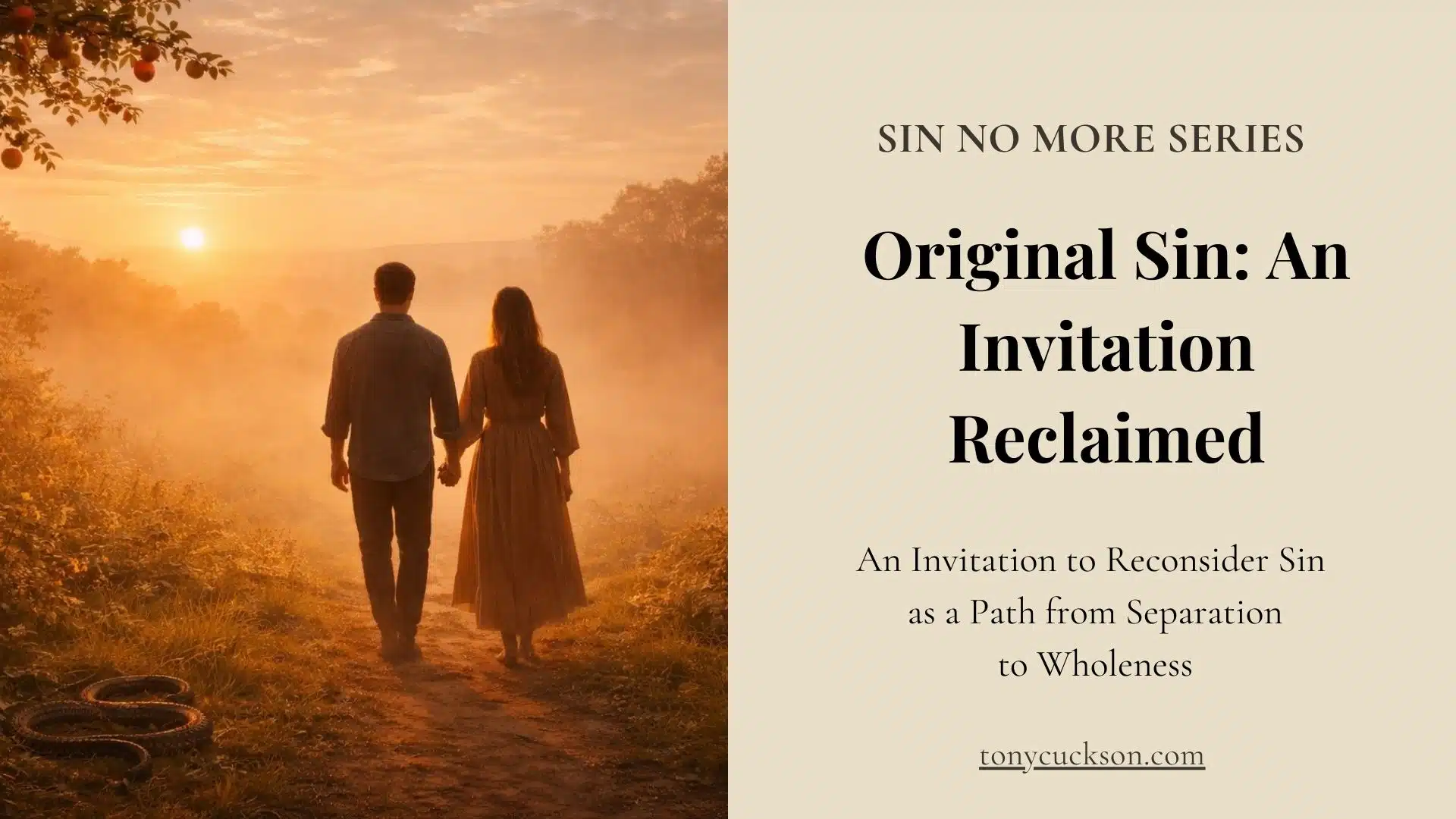
In order to further explore the meaning of sin we need to look at the phrase Original Sin is heard today, it rarely sounds like an inquiry. It sounds like a verdict. It names a condition assumed to be inherited, unchosen, and inescapable—a moral fracture present before desire, before action, before awareness itself. For many, this has quietly formed the background of Christian experience, shaping prayer, conscience, and self-understanding long before belief is ever examined. Christianity becomes something to manage rather than something to live, something to be forgiven from rather than something to awaken into.
But this was not always so. The earliest Christian proclamation was not centered on inherited guilt, but on awakening—on the announcement that the Kingdom of God was at hand, that LIFE was being offered, that the human being could be restored to right relationship with God not through fear, but through participation. Sin, in this earlier vision, was not primarily a stain on Being, but a distortion of perception, a turning away from what is already given. It described disconnection, not condemnation.
Understanding how Original Sin came to mean what it now means is therefore essential if Christianity is to be experienced again as a path of freedom. The question is not whether humanity is broken, but how that brokenness has been named. When a diagnosis becomes a sentence, fear follows naturally. When it becomes an invitation to healing, the entire landscape changes. What was once experienced as judgment begins to reveal itself as a call back into communion.
his inquiry is not undertaken to dismantle Christianity, but to listen more carefully to it. To ask whether the weight carried by so many was ever meant to be borne at all. To notice how a phrase, once intended to explain the human condition, gradually became a lens through which all experience was filtered. And to sense, perhaps for the first time, that beneath the language of sin there has always been a quieter invitation—an opening into Presence, into KNOWING, into a way of life no longer governed by fear.
If Christianity is to be lived as life more abundant, then the story it tells about what it means to be human must itself be life-giving. Tracing the origin of Original Sin is not a rejection of the faith, but a return to its deeper promise. What appears at first as a doctrine may, when approached gently, reveal itself as a doorway—one that leads not into shame, but into freedom.
Having been brought up in Northern Ireland within traditional and fundamentalist Christian churches, it seemed to me that the central focus of the Master’s teaching was sin. Not as a doorway into transformation, but as a defining condition of existence. From an early age, the atmosphere of faith was heavy with warning rather than wonder, vigilance rather than joy. The message was clear and unambiguous: I was a sinner, and I would pay. This was not presented as a possibility to be explored, but as a certainty to be accepted.
What this produced was not rejoicing, but guilt—guilt for a condition I had no part in creating and no way of escaping. Before desire, before choice, before any conscious turning of the will, the verdict had already been pronounced. Sin was not something I did; it was what I was. The Christian life, as it was offered, became an ongoing reckoning with this fact, a continual effort to remain acceptable in the face of an inherited fault.
Yet even then, something in this never felt right. It did not resonate with the tone of the Master’s voice as I encountered it in the Gospels. The invitation to LIFE, the repeated turning toward those already burdened, the ease with which forgiveness flowed—none of this sat comfortably alongside a theology that required fear as its primary motivator. The weight of guilt felt imposed rather than revealed, learned rather than discovered.
In these later years, I have come to understand that the word sin, and even the doctrine of Original Sin, were never intended to produce this inner atmosphere. Their purpose was not to shame the human Being, nor to anchor identity in failure. What they were pointing toward was something altogether different: a diagnosis of disconnection, a naming of how humanity loses its way, and an invitation to return. Sin, rightly understood, was meant to awaken, not accuse.
Seen in this light, the doctrine does not condemn the human story; it illuminates it. It describes not a debt to be paid, but a condition to be healed. The tragedy was never that humanity was guilty, but that humanity forgot who it was. When this distinction is lost, Christianity becomes a religion of fear. When it is remembered, Christianity opens again as a path of freedom, grounded not in guilt, but in restoration.
The doctrine known as Original Sin did not originate with the Master. Nowhere in the Gospels does he speak of inherited guilt, a fallen nature transmitted through generations, or a primordial fault carried by the human Being from birth. His concern was always immediate and relational—how people were living, what they were bound by, and how they might be set free. Sin, when he named it at all, was something encountered in the present moment, not a verdict pronounced in advance.
The formal doctrine of Original Sin entered Christian thought through the work of St. Augustine, writing in the late fourth and early fifth centuries. Augustine was responding to real and pressing questions: the persistence of suffering, the universality of human failure, and the undeniable sense that something in the human condition was disordered. His reflections were pastoral as much as theological, shaped by his own life experience and by the intellectual currents of his time. He was not attempting to create a religion of fear, but to make sense of a shared human struggle.
What is often forgotten is that Augustine’s concern was explanatory, not punitive. He was trying to describe why human beings so frequently act against their own deepest good, why desire fractures, why will and action fall out of alignment. His language, though later hardened into doctrine, was originally an effort to understand the human condition, not to condemn it. Sin, for Augustine, was bound up with disordered love and misdirected desire, not with inherent worthlessness.
It seems unlikely that Augustine would recognize—let alone endorse—the atmosphere of shame and wrongness that later grew around his thought. The transformation of his reflections into a doctrine that promotes fear, guilt, and a sense of essential defect would have been deeply troubling to a man whose entire spiritual journey was oriented toward the healing of desire and the restoration of love. What began as an attempt to illumine the human predicament gradually became a lens through which humanity itself was judged.
This distinction is crucial. When Augustine is read carefully, Original Sin does not declare that humanity is bad, but that humanity is wounded. It does not deny the goodness of Being, but acknowledges its distortion. The tragedy lies not in Augustine’s inquiry, but in how that inquiry was later received—flattened into certainty, weaponized into control, and separated from the invitation to understanding that originally animated it.
To explore how sin can be understood not as a sentence but as a doorway to liberation, I have been unfolding the series Sin No More. The intention of this series is not to diminish the seriousness of sin, but to release it from the moral atmosphere that has so often obscured its deeper meaning. What is being named here is not wrongdoing in the conventional sense, but a way of seeing—a perception that quietly governs the human experience.
Sin, as it is being shared in this work, is best understood as the belief in separation. This belief is not an error in the sense of a mistake to be punished; it is a fundamental feature of the human condition. It is the experience of oneself as a separate personal self, existing apart from God, apart from LIFE, apart from the whole. This belief shapes perception, desire, fear, and identity, and it is so pervasive that it often goes unnoticed. It simply feels like what it means to be human.
This belief is not bad. It is not a moral failure, nor a flaw in Being. Yet it is not the truth of who you are, nor the truth of why you are. Sin names this dissonance—not to accuse, but to illuminate. It points to the gap between lived experience and deeper reality, between the sense of separation and the underlying unity that remains unrecognized. In this way, sin functions not as condemnation, but as revelation.
Within the realm of ordinary human experience, it is therefore true to say that one is a sinner. But this truth carries no requirement of guilt. The experience of separation is not something to be ashamed of; it is something to be understood. It belongs to the way the Divine order has been established in this dimension of existence. To be born into human life is to be born into this perception, to inherit not a crime, but a condition.
Seen from this perspective, Original Sin simply names the fact that, by virtue of being born into the human world, one enters into the experience of separation. It is original not because it is a transgression, but because it is foundational. It precedes choice, intention, and moral agency. It is the starting point of the human journey, not its failure.
The forgiveness of sin, then, is not the overlooking of wrongdoing by an offended God. It is the release from misidentification. It is the gradual unlearning of the belief that one is separate from the Divine, and the rediscovery of a deeper truth that has never been lost. Forgiveness names the movement beyond separation, beyond fear, and beyond the burden of a self that must continually defend its own existence.
When sin is understood in this way, it no longer imprisons. It becomes the very doorway through which liberation is entered—not by denial of the human condition, but by seeing it clearly and allowing it to be transcended. What was once experienced as guilt is transformed into understanding, and what was once feared is revealed as an invitation home
When the origin of Original Sin is seen clearly, something quiet but profound begins to shift. What once appeared as a sentence imposed upon the human story is revealed as a description of the starting point of that story. Fear loosens its grip, not because sin is denied, but because it is finally understood. The belief in separation, once mistaken for a moral failure, is recognized as the very terrain through which awakening becomes possible. In this light, Christianity no longer asks the human Being to carry guilt for what it means to be human, but invites participation in the slow remembering of what has always been true. Sin no longer stands as a barrier to LIFE, but as the doorway through which LIFE is consciously entered, and the Christian way is restored as a path not of fear, but of freedom.
If these reflections have stirred questions or opened space for deeper seeing, you are invited to explore the full Sin No More Series. There, each writing unfolds another facet of the movement from guilt and separation into forgiveness, freedom, and LIFE. Together, they trace a quiet but profound release from condemnation into the wholeness the Master promised.
Understanding the Nature of Sin No More Series
These writings belong to a contemplative series exploring sin not as a moral tally or an inherited stain, but as a lived condition of separation—one that obscures LIFE until it is seen clearly and released.
Together, they trace the inner movement by which guilt gives way to truth, fear yields to freedom, and the demand for moral striving is replaced by awakening to union. Sin is revealed not as identity, but as misunderstanding; not as condemnation, but as the doorway through which liberation becomes possible.
Rather than urging self-improvement, this series listens for the voice that speaks without accusation, inviting a return to wholeness where forgiveness is not earned, but recognized, and where “sin no more” arises naturally from restored Being rather than enforced restraint.
Sin No More Series
What Is a Sin in Christianity? A Deeper Understanding Beyond Guilt
The Origin of Original Sin: From Inherited Guilt to the Doorway of Freedom
Original Sin Explained — From Guilt to Repentance
The Wages of Sin Is Death Meaning — From Separation to Eternal Life
What Is the Meaning of Sin? From Guilt to Liberation