belief vs faith

The question of belief vs faith has been asked for centuries, yet it remains one of the most misunderstood questions in the spiritual life. In many religious traditions the words belief and faith are used almost interchangeably. To believe is assumed to be the same as having faith, and having faith is often described simply as believing strongly enough in what one has been taught. For many sincere seekers this understanding feels sufficient for a time. Belief offers structure. It provides language for speaking about the Divine and creates a sense of belonging within a spiritual community.
Yet there comes a moment for many people when belief alone no longer seems to answer the deeper questions of the heart. A person may sincerely want to believe. They may study sacred texts, listen carefully to those who speak with authority, and do their best to accept the doctrines they have inherited. And yet something remains unsettled. The words are understood, but the experience they describe seems distant. The teachings may be admired, yet the living reality they point toward feels somehow beyond reach. It is often at this point that the question of belief vs faith begins to take on new significance.
The distinction between these two words may appear subtle at first, but in lived experience it can become profound. Belief is most often an agreement with an idea. It is the acceptance of a proposition about God, about scripture, or about the nature of spiritual truth. Belief lives primarily within the realm of thought. It can be studied, defended, debated, and refined. In many cases belief is inherited from a tradition long before it is examined in the light of personal experience. Families pass it to their children, teachers pass it to their students, and communities preserve it across generations. None of this makes belief unimportant. Belief can orient the heart and provide a framework through which spiritual life begins.
Yet belief also has limits. A person can believe something sincerely and still discover that belief alone does not necessarily lead to direct encounter with the reality it describes. One may believe in peace without actually abiding in peace. One may believe in forgiveness without ever experiencing the freedom of releasing resentment. In the same way, one may believe in God without ever entering into the living experience of the Divine Presence.
This discovery can feel unsettling, particularly for those who have been taught that belief itself is the central requirement of faith. Many people assume that if belief feels uncertain, it must mean that something has gone wrong in their spiritual life. They may try to believe more strongly, pray more intensely, or study their religious tradition with greater discipline. For some this renewed effort does bring reassurance. For others it leads to an unexpected realization: the struggle may not be with faith at all, but with belief.
This recognition does not require the rejection of belief, nor does it ask anyone to abandon the traditions that have shaped their lives. Belief can be understood as a beginning rather than a conclusion. It may serve as a signpost pointing toward a deeper landscape. The difficulty arises only when the signpost itself is mistaken for the destination.
For many seekers the first real movement of faith begins when this possibility becomes visible. Faith, in its deeper sense, is not simply the strengthening of belief. Instead it involves a willingness to step beyond the certainty that belief appears to provide. Faith becomes the courage to enter what cannot yet be fully explained. It is the openness to encounter the Divine not merely through inherited descriptions, but through living experience.
The reflections that follow explore the unfolding movement that many seekers experience in the spiritual life:
Belief → Faith → Knowledge → KNOWING → Silence → Being
This movement forms the deeper arc of the spiritual journey.
Table of Contents
What Is the Difference Between Belief and Faith?
The difference between belief and faith is subtle but important. Belief usually refers to accepting an idea as true, while faith involves trusting and entering into a reality that cannot yet be fully explained or controlled.
When people ask about the difference between faith vs belief, they are often trying to understand whether these two words describe the same spiritual reality. In everyday religious language they are frequently used as though they mean the same thing. Yet in lived spiritual experience a subtle but important distinction often emerges.
Belief usually refers to accepting an idea as true. A person believes something because it has been taught, because it seems reasonable, or because it aligns with the tradition they trust. Belief lives primarily in the realm of thought and interpretation. It provides a framework through which spiritual teachings can be understood and discussed.
Faith, however, points toward something deeper than agreement with an idea. Faith is not simply believing more strongly. Faith is the willingness to trust what cannot yet be fully explained. It involves openness to the unknown and the courage to move beyond inherited explanations into direct encounter with the Divine.
In this sense belief often begins the journey, while faith allows the journey to continue. Belief points toward truth; faith invites the seeker to enter the living experience of that truth.
This distinction becomes clearer as the spiritual journey unfolds. What begins as belief may deepen into faith, and faith may eventually open into the direct recognition that spiritual traditions describe as KNOWING.
When Belief Is No Longer Enough
There often comes a moment in a person’s spiritual life when belief begins to feel insufficient. Nothing dramatic may have happened outwardly. One may still attend religious services, read sacred texts, and affirm the teachings that have shaped one’s faith tradition. Yet inwardly something has shifted. Questions begin to arise that cannot easily be dismissed. The words once repeated with confidence now invite deeper reflection. The seeker may discover that what once felt settled has become open again.
This moment should not be mistaken for failure. In many cases it is a sign of sincerity. A person who never questions belief may never move beyond it. The one who begins to ask quietly whether belief alone is enough has often begun to sense that spiritual life involves more than agreement with inherited ideas. Something within them is asking to encounter the reality those ideas were meant to describe.
Many people respond to this moment by trying harder to believe. They pray more intensely, study their scriptures more carefully, and attempt to strengthen their conviction. For some this renewed effort restores a sense of certainty. For others, however, the deeper questions remain. They may discover that belief can be repeated with the mind while the heart still longs for something more immediate.
It is here that the distinction between belief and faith begins to reveal itself.
Belief tends to hold tightly to what it thinks it knows. Faith, by contrast, begins to loosen that grip. Faith does not always begin with certainty; often it begins with openness. It allows the seeker to admit honestly that belief alone has not yet become living experience. This admission can feel unsettling because belief has often been associated with spiritual security. Yet this willingness to stand without immediate certainty is often the very beginning of faith itself.
Many seekers recognize this stage as the beginning of their deeper journey. The experience is explored more directly in Is Faith the Same as Belief, where the subtle but important difference between belief and faith is examined more carefully.
When Faith Appears to Be Lost
There is a moment in the spiritual life that can feel deeply unsettling. What once seemed certain begins to loosen. The beliefs that once felt stable no longer carry the same weight they once did. Questions that were once quietly set aside begin to return with greater insistence. It is often at this point that a person begins to wonder whether they are losing their faith.
Yet it may be helpful to ask a different question. When someone feels they are losing their faith, what exactly is being lost? For many people, faith and belief have been treated as though they are identical. If belief begins to weaken, it is assumed that faith itself must be disappearing. But these two realities are not the same. What often collapses during such seasons of questioning is not faith itself but the structure of belief that once carried a person’s understanding of the Divine.
Beliefs are frequently inherited long before they are personally examined. They are received from families, traditions, and communities that have preserved certain explanations of spiritual truth. These beliefs may serve well for many years. Yet there may come a time when those explanations no longer seem capable of holding the depth of one’s lived experience.
When this happens, it can feel like loss. Yet it may actually be the beginning of awakening. What appears to be the loss of faith may simply be the loosening of inherited beliefs so that something deeper can emerge. Instead of relying on second-hand explanations, the seeker begins to explore the reality toward which those explanations were pointing. What many people call “loss of faith” may therefore be the threshold of a deeper spiritual awakening. This turning point is explored more fully in What Causes Loss of Faith.
The Difference Between Belief and KNOWING
When belief begins to loosen, space opens for something deeper to emerge. Ideas that once seemed necessary to hold onto are no longer clung to in the same way. The seeker begins to discover that letting go of certainty does not lead to emptiness but to openness. This openness reveals the difference between belief and KNOWING.
Belief lives primarily within the mind. It is an agreement with an idea about reality. A person believes something to be true because it has been taught, because it seems reasonable, or because it aligns with the tradition they trust. Belief may be sincere and deeply meaningful, yet it remains a relationship with an explanation rather than with the reality itself.
KNOWING belongs to an entirely different order of experience. KNOWING is not the acceptance of an idea but the recognition of a reality that is directly encountered. It arises not from argument but from participation. When something is known in this deeper sense it is no longer held as a belief that must be defended. It becomes a lived recognition that reveals itself through experience.
Most people understand this difference in ordinary life. One may believe that fire is hot because someone has explained it. But once the warmth of the fire is actually felt, belief is no longer required. The experience itself carries its own certainty.
In the same way spiritual traditions speak of realities that can be believed or directly known. One may believe in peace without experiencing peace. One may believe in God without encountering the Divine Presence directly. KNOWING refers to that direct encounter. It is experiential rather than conceptual. It is immediate rather than second-hand. It is embodied rather than merely understood. This movement from conceptual belief into direct experience is explored more deeply in Belief vs KNOWING.
The Spiritual Invitation Hidden Within Faith
Once the distinction between belief and KNOWING begins to emerge, faith itself begins to take on a deeper meaning. Faith is not certainty. Faith is the willingness to step beyond certainty. Where belief seeks security through conclusions, faith invites trust in the unfolding mystery of life. In this sense faith becomes a form of surrender.
This surrender does not mean abandoning intelligence or refusing to ask questions. Rather it involves releasing the need for the mind to define the Divine before encountering it. The Infinite cannot be contained within the ideas that attempt to describe it.
This deeper meaning begins to illuminate the teachings attributed to the Master. When the Master says, “Deny thyself, take up your cross, and follow me,” the words point beyond outward behaviour toward an inner transformation. To deny thyself is to loosen identification with the separate self that seeks certainty and control. To take up your cross is the willingness to allow the structures that support that identity to dissolve. To follow is to walk the path that leads beyond belief into direct encounter with the Presence to which the Master pointed. Faith becomes the courage to remain open when certainty dissolves. And that openness prepares the way for the next movement in the journey.
Be Still and Know That I AM God
If belief cannot bring the seeker into direct encounter with the Divine, and if faith invites surrender of certainty, the question naturally arises: how does this deeper knowing begin? The scriptures offer a remarkably direct invitation.
“Be still, and know that I am God.”
Stillness in this sense does not simply mean quieting the body or calming the mind. It refers to the quieting of the restless activity of the personal self. The separate self is constantly interpreting, analysing, remembering, and anticipating. It attempts to organise reality into conclusions it can control.
Yet this activity can obscure the deeper Presence that spiritual traditions point toward. When this activity softens, awareness becomes open and receptive. In that stillness the sense of distance between the seeker and the Divine begins to dissolve. What once appeared as something to be believed in from afar begins to reveal itself as a Presence already nearer than thought. This is the beginning of KNOWING.
The deeper meaning of this invitation is explored more fully in How to KNOW God, and in the reflection Be Still and Know That I AM God.
From Belief to KNOWING
When we step back and observe the journey we have explored, a clear pattern begins to emerge.
Belief often begins the journey.
Faith opens the unknown.
Stillness reveals Presence.
KNOWING fulfills what belief was pointing toward.
As this recognition deepens, the mind naturally becomes quieter. The need to constantly define experience softens. In that quiet the seeker begins to recognise the Presence that has always been nearer than thought.
Related Questions About Belief and Faith
As seekers explore the relationship between belief and faith, a number of related questions often arise. Some ask whether belief must always precede faith, while others wonder whether faith can exist when belief begins to loosen. Still others begin to explore how faith relates to direct spiritual KNOWING, or whether the teachings of the Master point beyond belief toward a deeper experience of the Divine Presence.
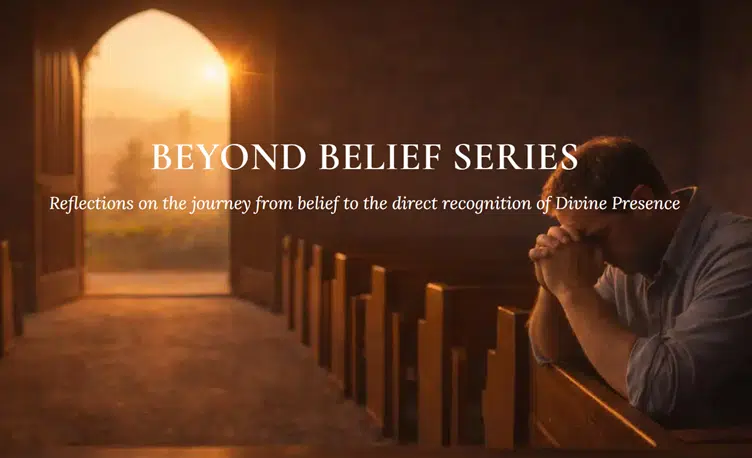
These questions form part of the broader journey explored throughout the Beyond Belief Series, where each reflection looks more closely at a particular stage of the movement from belief toward KNOWING.
You may wish to explore these related reflections:
- Is Faith the Same as Belief
- Is it Normal to Struggle with Faith
- What Causes Loss of Faith
- Belief vs KNOWING
- How to KNOW God
Beyond Belief
Belief should never be dismissed. It often represents the first sincere turning of the heart toward the Divine. Belief can orient the seeker and preserve wisdom passed down through generations.
Yet belief is not the end of the journey. Belief is a signpost. KNOWING is the territory. Belief may begin the journey, but it cannot complete it. The invitation of the spiritual life is not merely to believe in the Divine but to awaken to the Presence in which we already live. If you would like to explore the full collection of reflections in this series, you may visit the Beyond Belief Series page.
Frequently Asked Questions
Is belief the same as faith?
Belief and faith are often used interchangeably, but they are not identical. Belief usually refers to accepting an idea as true, while faith involves trusting and entering into a deeper spiritual reality that may not yet be fully understood.
What is the difference between belief and faith?
The difference between belief and faith lies in their depth of experience. Belief often lives in the mind as agreement with an idea, while faith invites a person to trust and move beyond certainty into direct spiritual encounter.
Can faith exist without belief?
Faith often begins where belief begins to loosen. While belief can point toward spiritual truth, faith allows a person to remain open to the mystery of the Divine even when certainty is no longer present.
Beyond Belief Series
Many spiritual seekers begin with belief — ideas about God, faith, and truth that shape the way life is understood. Yet belief alone does not always quiet the deeper questions of the heart. One may believe the right things and still sense uncertainty within.
The Beyond Belief series explores the difference between belief and faith and the deeper journey from belief toward direct spiritual KNOWING. Through these reflections, the teachings of the Master are approached not merely as statements to believe, but as invitations to awaken.
Series Path
Begin Here
Belief vs Faith
Understanding the Question
Is Faith the Same as Belief
Belief vs Knowing
When Faith Feels Uncertain
Is It Normal to Struggle With Faith
What Causes Loss of Faith
Moving Toward KNOWING
Be Still and Know — Meaning
How to KNOW God
The Master’s Deeper Invitation
What Does Deny Yourself Mean in the Bible
Whosoever Believes in Me Shall Never Die