take no thought for tomorrow meaning
Many people search for the meaning of “Take no thought for tomorrow” because the words of Jesus in Matthew 6:34 seem at once comforting and impossible. Are we truly not meant to think about the future? Is this simply advice about anxiety, or is something far deeper being invited? To understand what Jesus meant, we must look beyond the surface reassurance these words are often reduced to and allow them to question the very structure of how we live.
Few sayings of the Master have been quoted more frequently and understood less deeply. Over time, “take no thought for tomorrow” has been softened into a gentle suggestion not to worry, as though Jesus were offering emotional support for troubled minds. Yet the phrase does not say, “Try to worry less.” It does not advise improved emotional management or more positive thinking about the future. It says, quite plainly, “Take no thought.” The simplicity of the instruction is so direct that it has almost compelled reinterpretation. We have made it safer than it was meant to be.
If we approach the saying honestly, we must admit that most human lives are structured around tomorrow. The mind moves ahead of the present moment almost without pause. It anticipates, plans, rehearses conversations that have not yet happened, calculates outcomes, and attempts to secure what is not yet visible. Even in stillness, there is often a subtle leaning forward into what might come next. This movement feels normal because it is universal. Yet the Master speaks directly into this normality and quietly invites something altogether different.
Not Simply Advice About Worry
To understand the true meaning of “take no thought for tomorrow,” we must first see that Jesus is not addressing worry at its surface level. Worry is only the visible ripple of a much deeper current. Beneath anxiety lies identification with the thinking mind itself — the unquestioned belief that life must be secured, defended, and authored through thought. When the mind believes it is responsible for guaranteeing the future, it naturally becomes restless. The instruction, therefore, is not about suppressing anxious feelings but about seeing through the assumption that thought is the source of safety and control.
Tomorrow, when examined closely, exists only as a concept. When tomorrow arrives, it is no longer tomorrow; it is called today. Yet the mind sacrifices the immediacy of the present in order to manage an imagined future. In doing so, it lives more in projection than in actuality. The Master’s words expose this habit with astonishing gentleness. He is not advocating carelessness or passivity, nor is he dismissing practical responsibility. Instead, he is inviting a shift in the origin of action. Action may still arise. Decisions may still be made. Commitments may still be honoured. But they need not arise from anxious rehearsal. They may emerge from Presence rather than projection.
The Limits of the Thinking Mind
The depth of this teaching becomes clearer when the Master asks, “Which of you by taking thought can add one cubit unto his stature?” This question is not decorative rhetoric. It quietly reveals the limits of mental authorship. You may imagine the future in countless ways, but imagination cannot enlarge your Being. You may rehearse outcomes endlessly, yet the essential unfolding of life remains beyond your control. Thought has a practical role within the world of time and space, yet it does not generate LIFE itself.
The ordinary human mind — what St. Paul called the carnal mind — operates through comparison and opposition. It thinks in terms of gain and loss, success and failure, pleasure and pain. It assumes itself to be a separate center responsible for preserving its own existence. From that assumption, tomorrow becomes something to manage and defend against. The future is approached as a potential threat rather than as a natural unfolding within a greater order. Anxiety is not imposed from outside; it is the natural consequence of believing oneself to be isolated and solely responsible.
When Jesus says, “Tomorrow shall take thought for the things of itself,” he is pointing toward an intelligence deeper than personal calculation. There is an order to life that does not depend upon anxious anticipation. The Divine does not wait for your mental rehearsal before acting. This does not remove you from participation; rather, it invites you into a different mode of participation — one not driven by fear.
From Separation Into Wholeness
To grasp the meaning of “Take no thought for tomorrow” is therefore to see that the instruction addresses identity more than behaviour. It questions the very sense of a separate self that believes it must carry life alone. This is why the teaching cannot be reduced to emotional comfort. It touches the root of self-identification. The Master lived from what Paul later described as the Mind of Christ — a mode of awareness not fragmented by opposites, not structured around self-preservation. When Jesus says, “I can of mine own self do nothing,” he is not confessing weakness but revealing freedom from personal authorship. Action flows, words are spoken, works are accomplished, yet no separate center rises to claim ownership.
In this light, “take no thought for tomorrow” becomes inseparable from “Deny thyself.” The self that is denied is not your humanity, nor your uniqueness, nor your capacity for intelligence. It is the imagined autonomous self that believes it stands apart from the Divine source of LIFE. To deny that self is not annihilation; it is release. It is the loosening of the belief that life must be secured through constant mental vigilance. When this loosening begins, even subtly, something within you relaxes. The future is no longer an adversary. The present becomes sufficient.
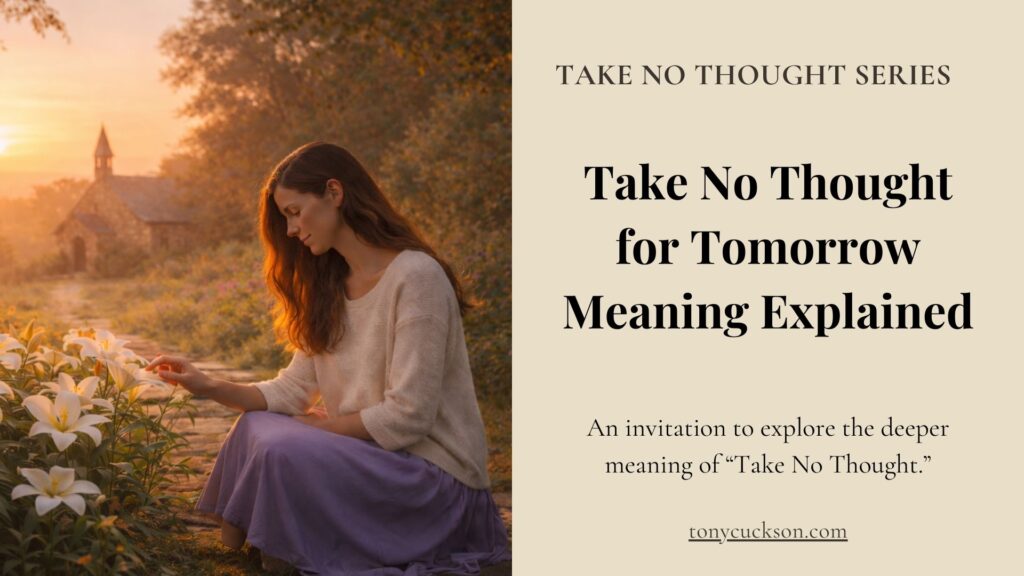
The Master’s invitation finds perhaps its most tender expression when he says, “Consider the lilies of the field.” He does not ask you to theorize about them. He invites you simply to look. The lilies do not rehearse tomorrow. They do not strategize their growth. They participate in the intelligence of life without attempting to secure it. In the same way, he calls you back to the simplicity of the child who lives before the prison walls of constant mental interpretation close in. “Except ye be converted, and become as little children, ye shall not enter into the kingdom of heaven.” The child does not live by thinking about how to live. The child lives.
A Gentle Return to Presence
To take no thought for tomorrow is not to abandon responsibility, nor to cease planning when planning is required. It is to cease deriving your identity from the restless movement of thought. Plans may still be formed, but they are held lightly. Decisions may still be made, but they are not born of fear. Action arises from stillness rather than from anxiety. Tomorrow takes care of itself not because nothing unfolds, but because life is already moving within an intelligence greater than personal calculation.
If you have searched for the meaning of “Take no thought for tomorrow,” perhaps something within you sensed that this teaching carried more weight than simple advice about worry. The deeper meaning cannot be fully captured in explanation; it must be tested quietly in lived experience. Begin gently. Notice how often the mind moves into tomorrow. Notice also that you are aware of that movement. In that awareness there is already a dimension untouched by projection.
This reflection belongs within the wider unfolding of the Take No Thought series. Each meditation approaches the same centre from another angle — the carnal mind, the Mind of Christ, the lilies of the field, the question “which of you by taking thought,” and the invitation to deny the separate self. They are not separate doctrines but facets of one unveiling. The words are signposts. The territory is nearer than you think. It is not found in tomorrow.
It is here. And here is enough.
Take No Thought Series
This Take No Thought Series gathers sayings of Jesus that are often misunderstood and approaches them not as demands, but as invitations into Being. These reflections linger with the words themselves, allowing their inward movement to become clear.
Each article explores how these teachings move beyond surface meaning into KNOWING — where fear loosens, effort softens, and understanding deepens into Presence and LIFE.
Start Here
Take no Thought for Tomorrow Meaning
Reflection 1
Your Thoughts Are Not My Thoughts
Reflection 2
Reflection 3
Reflection 4