original sin explained
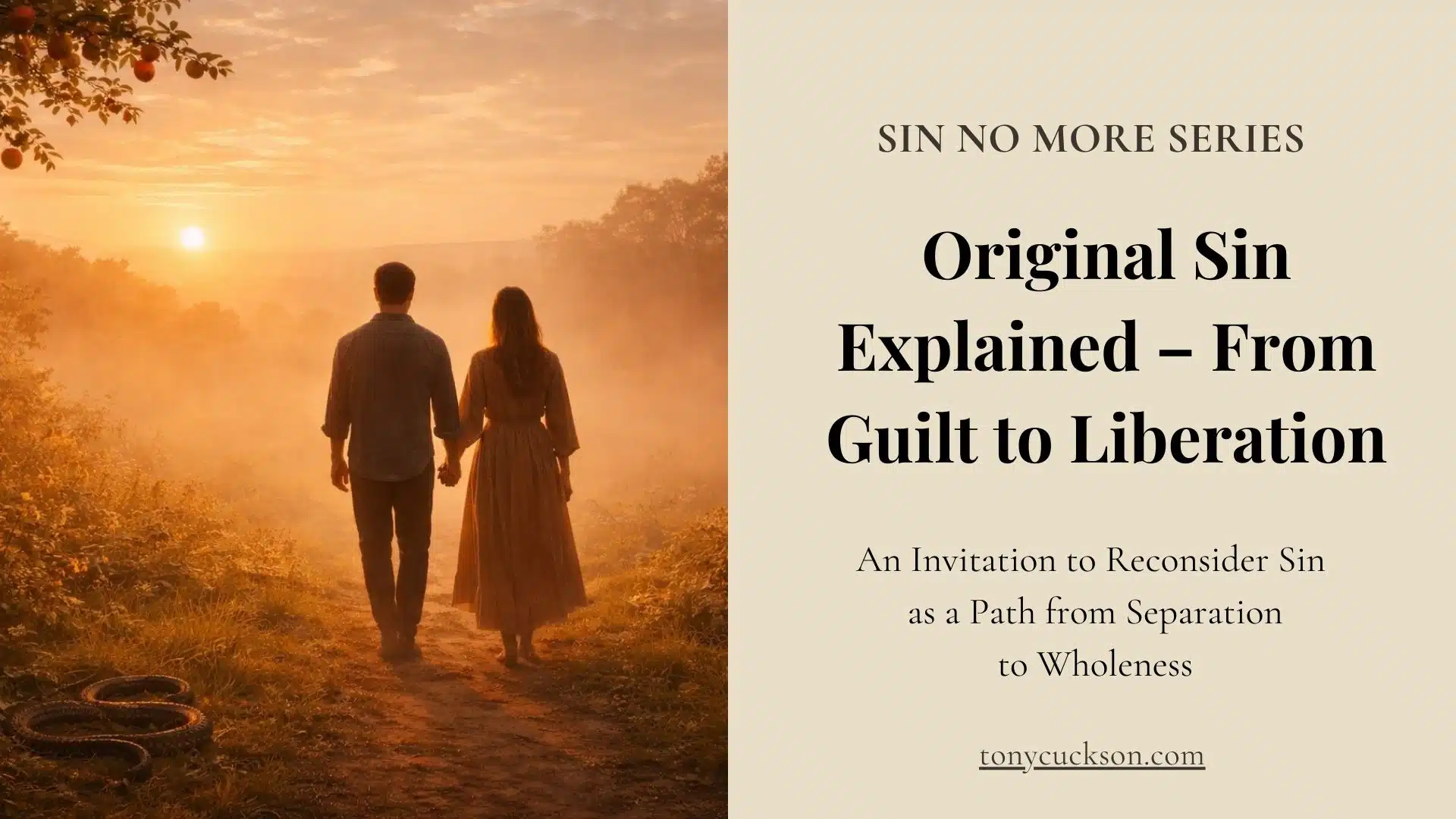
To understand Original Sin correctly matters more than is often acknowledged, because the way this concept is received shapes the entire inner atmosphere of the Christian life. When it is misunderstood, it produces a lingering sense of guilt—a feeling of wrongness carried not for what one has done, but for what one is believed to be. This burden does not lead to freedom or transformation; it quietly distorts the experience of faith itself. Yet when Original Sin is understood as it was originally intended, it no longer imprisons. It becomes a doorway into liberation, offering insight into the human condition and opening the way toward healing, wholeness, and LIFE more abundant rather than fear and self-judgment.
In my Christian upbringing in Northern Ireland, I learned to identify myself as a sinner. This identity was not something I consciously chose; it was something I absorbed. From an early age, it was made clear that sin was not merely something I did, but something I was. Yet this never sat easily within me. It carried a weight that felt misaligned with the invitation I sensed beneath the surface of the Christian story. Over time, this dissonance became one of the reasons I stepped away from the Church and began to explore other traditions, drawn toward paths where the emphasis was less on guilt and more on liberation.
For many people, whether religious or not, sin is understood almost exclusively as moral wrongdoing. It names the ways one fails to live up to an external standard, and redemption is imagined as something earned through correction, effort, or repentance sufficient to restore proximity to God. In this framework, guilt becomes a motivating force, and shame is often cultivated—sometimes explicitly, sometimes subtly—as a means of moral control. The underlying assumption is that transformation begins with self-condemnation.
Yet this is not the experience the word sin was originally pointing toward. What I have come to see is that the cultivation of shame and guilt does not heal the condition sin describes; it strengthens it. When a person is taught to feel fundamentally wrong, the sense of separation deepens rather than dissolves. The very dynamic that sin names—the belief in being separate from the Divine—is reinforced by a spirituality that requires self-judgment as its starting point.
Seen in this light, sin is not healed by condemnation, but by understanding. Liberation does not arise from learning to feel worse about oneself, but from seeing more clearly. When the false identity of being separate is gently exposed, it loosens its grip. What falls away is not moral responsibility, but the burden of shame that was never required. In this way, sin reveals itself not as a problem to be punished, but as an experience to be transcended—one that opens, paradoxically, into freedom rather than fear.
As I have continually pointed out throughout the Sin No More series, sin, as it is meant to be understood, is not concerned with moral wrongdoing in the way it is commonly assumed. It does not primarily describe behaviour that must be corrected in order to become acceptable to God. Rather, it points to a universal human experience—the lived sense of personal separation that shapes perception, identity, and action. This experience is not unique to a few; it belongs to the human condition itself.
Within the biblical tradition, this sense of separation is named in a variety of ways. St. Paul refers to it as the natural man (1 Corinthians 2:14), pointing to a way of awareness that lives from a self experienced as separate and self-defining. Elsewhere, this same condition is spoken of as the flesh (John 3:6) or the man of earth (1 Corinthians 15:47). These terms are not condemnations of the body, nor are they moral judgments about desire. They are descriptive, pointing to an orientation of life that is centred on the personal self and its apparent independence.
It is the natural man who lives from what is often called the carnal mind (Romans 8:6). This too has been widely misunderstood. The words flesh and carnal have frequently been given sexual or bodily meanings, as though they referred to particular impulses or behaviours that must be suppressed. Yet this was never their intention. They point instead to an awareness shaped by separation—one that interprets life through fear, lack, and self-protection rather than through union and trust.
When these terms are heard in this way, they lose their accusatory tone. They do not shame the human Being for having a body or for experiencing desire. They simply describe what it is like to live from a sense of separation, to move through life identified primarily as a personal self apart from the Divine. In naming this experience, Scripture is not condemning the human story, but making visible the possibility of seeing beyond it.
Understanding this distinction is crucial. When sin is mistaken for moral failure, the response becomes judgment and control. When it is recognized as the experience of separation, the response becomes compassion and awakening. The language shifts from accusation to invitation, and the human journey is revealed not as a struggle to become worthy, but as a movement beyond a mistaken sense of who one is and into the truth that has always been present.
When the focus of sin is placed on improving moral behaviour, the deeper invitation carried by this word is easily missed. Attention turns outward, toward correction and self-management, and the Christian life quietly becomes an ongoing project of refinement. What is overlooked is that this very focus strengthens the identification it is attempting to heal. Moral improvement, when taken as the primary aim, tightens the sense of being a separate personal self—the natural man, the man of earth—rather than loosening it.
Shame and guilt, far from dissolving separation, only thicken it. They reinforce the inner posture of distance, creating a felt wall between oneself and God. Yet this wall does not exist on the side of the Divine. The Divine is not separate, not divided, not withheld. There is no distance there to be crossed. The sense of separation is experienced entirely within the human awareness, sustained by identification with a self that believes it must earn its way back to God.
The invitation carried by the word sin is therefore not toward self-improvement, but toward turning. This is the true meaning of the word repent—not to feel remorse, but to turn within. It is an inward movement of awareness, away from the assumption of separation and toward what has always been present. One turns within because the Kingdom of Heaven is within, not as a future reward, but as a present reality waiting to be recognized.
This turning is not something the personal self accomplishes. It is a yielding rather than an effort, an opening rather than an achievement. In this turning, one is not made worthy; one is shown what has always been true. The sense of separation begins to fall away, not through struggle, but through grace. What is revealed is a non-separate experience of Being that gives rise to KNOWING—not belief, not hope, but the quiet certainty of eternal LIFE already at hand.
What remains, then, is not further explanation, but a decision. Whether one will repent in the way this word truly invites. This repentance has nothing to do with overcoming guilt or resolving shame, for these belong to the very awareness of separation that is being transcended. The invitation is simpler and more demanding than that. It is to turn one’s attention within and to live in alignment with the Presence of the Divine already dwelling there.
The first step in this journey of revelation is not complex. It is not hidden, nor reserved for the spiritually advanced. It is simply to do what the Master says to do. Again and again, he points not toward effort, but toward release. “Take no thought for your life…” (Matthew 6:25). This is not moral advice, nor an encouragement toward passivity. It is an invitation into a different way of awareness—one that no longer lives from fear, lack, or self-protection, but from trust in what is already given.
Few Christians have been taught to explore the quiet power of this invitation. It is often read, explained, or spiritualised, but rarely lived. Yet to “take no thought” is to loosen the grip of the separate self, to step out of the anxious movement of the natural man and to rest, even momentarily, in a deeper ground of Being. This is not an escape from life, but an entry into it. It is here that the sense of separation begins to soften, and the experience named by the word sin starts to dissolve.
This turning within is not the end of the journey, but its true beginning. It opens the way for grace to be recognized rather than sought, and for freedom to be received rather than achieved. What is revealed is not a better version of the personal self, but the Presence that has always been nearer than breath. In this recognition, repentance fulfils its purpose, sin loses its hold, and LIFE is known not as a promise, but as a living reality.
I write this website, and I write the Sin No More series, so that you might encounter the invitation the word sin can be for you. For a long time in my own life, this word was a burden rather than a doorway. It carried weight, fear, and distance, and eventually I left the Church, believing that this atmosphere of guilt could not be reconciled with the life the Master spoke of.
Many years later—nearly sixty—I find myself returning. Not to the Church as an institution shaped by fear, but to the Church built without hands (2 Corinthians 5:1), where communion is not mediated by judgment, but discovered in Presence. It is here that I have come to know a Love that has never been absent, a Presence that KNOWS me by heart and has loved me all my life, long before I ever knew how to name it.
It is my hope that you might explore this series with a similar openness. Not to overcome sin, but to understand what it is truly pointing toward. Not as a veil that thickens the sense of separation between you and God, but as an invitation into liberation. When sin is seen clearly, it no longer obscures Love. It becomes the place where the illusion of separation loosens, and the way home reveals itself as having always been open.
Understanding the Nature of Sin No More Series
This series explores the meaning of sin through the words of Jesus, not as moral accusation or inherited guilt, but as a misunderstanding of Being that gives rise to separation, fear, and striving. Rather than reinforcing shame, these writings trace the quiet movement by which truth dissolves guilt, forgiveness restores union, and freedom emerges naturally when illusion is seen clearly.
Each article approaches sin not as identity, but as a condition that can be outgrown through awakening. Together, they invite a release from condemnation into LIFE itself, where “sin no more” is not a command to obey, but a reality that unfolds as separation ends and wholeness is remembered.
Articles in This Series
The Origin of Original Sin: From Inherited Guilt to the Doorway of Freedom
https://tonycuckson.com/origin-of-original-sin
Original Sin Explained — From Guilt to Liberation
https://tonycuckson.com/original-sin-explained
The Wages of Sin Is Death Meaning — From Separation to Eternal Life
https://tonycuckson.com/the-wages-of-sin-is-death
What Is the Meaning of Sin? From Guilt to Liberation
https://tonycuckson.com/what-is-the-meaning-of-sin
The Forgiveness of Sins Meaning: Beyond Moral Pardon
https://tonycuckson.com/forgiveness-of-sins-meaning
Go Sin No More — Meaning
https://tonycuckson.com/go-sin-no-more-meaning